
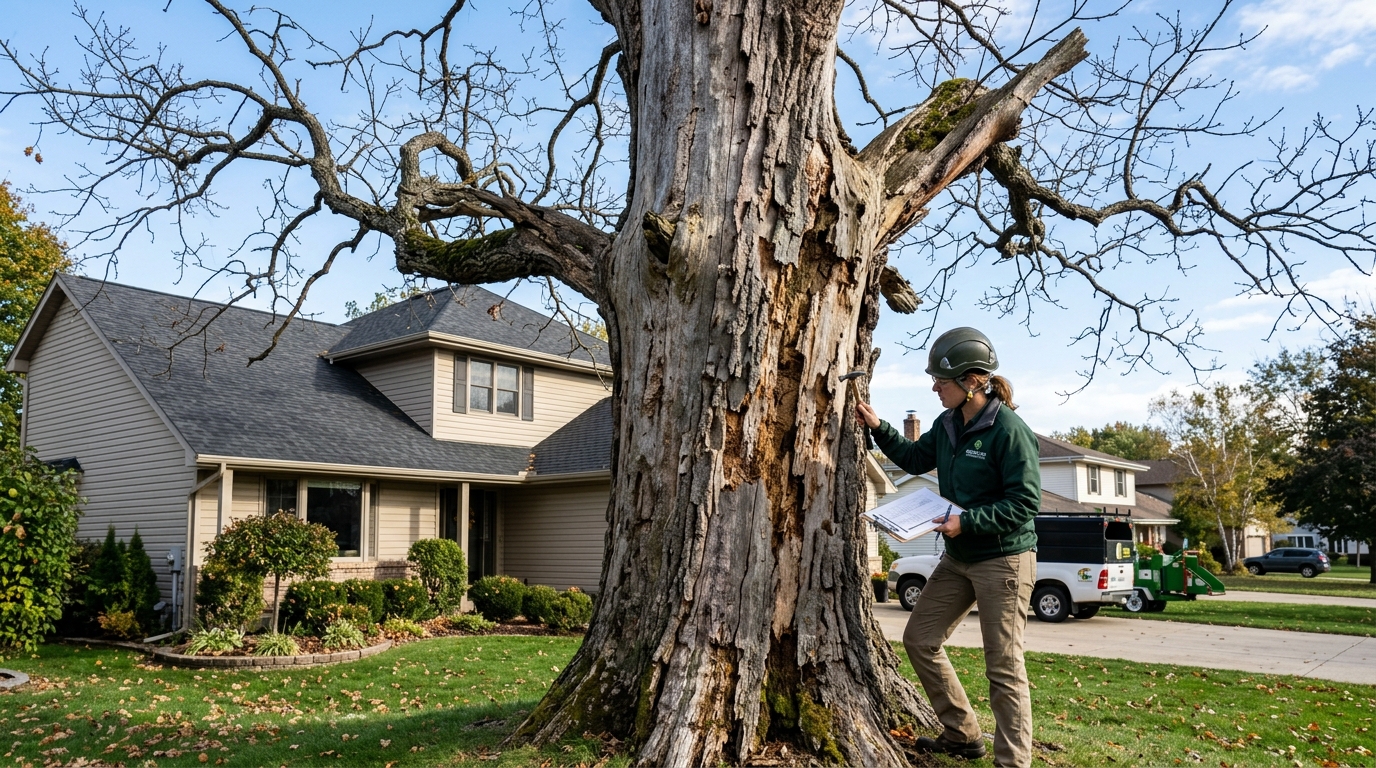
A dead or structurally compromised tree poses a tremendous safety hazard to your family, your home, and neighboring properties. During severe thunderstorms, hurricanes, or heavy snow loads, decaying trees are the primary cause of catastrophic roof collapses and utility power outages.
Early detection allows you to safely remove or treat a tree before an emergency occurs. Here are the 7 critical warning signs that indicate a tree is dying and requires immediate evaluation by a certified arborist.
1. Bark Peeling, Deep Vertical Cracks & Seams
Bark is a tree's protective armor. When a tree is healthy, bark remains firmly adhered to the trunk.
- Warning Sign: Large sheets of bark shedding and exposing bare, smooth, or discolored wood underneath.
- Structural Cracks: Deep vertical splits or seams extending deep into the trunk signify internal wood decay and structural instability under wind shear.
2. Fungus and Mushroom Growth at the Trunk Base
Mushrooms (conks or bracket fungi) growing along the root flare or lower trunk are never just cosmetic. Fungi thrive exclusively on dead and decaying organic matter.
- Warning Sign: Shelf-like mushrooms or clusters of honey mushrooms indicate advanced heartwood rot or root rot. The internal anchor system of the tree may already be hollowed out.
3. Sudden Lean or Exposed Root Mounds
While some trees naturally grow at a gentle angle toward sunlight, a sudden lean is a 5-star emergency.
- Warning Sign: A tree that tilts noticeably after a rainstorm, accompanied by soil heaving, cracked earth, or sheared roots protruding from the ground opposite the lean.
- Action Required: Cordon off the fall zone immediately and contact an emergency tree service.
4. Canopy Dieback and "Stagheading"
Healthy trees distribute water and nutrients evenly to the highest points of their crowns.
- Warning Sign: When top branches lose leaves, turn brittle, and resemble bare antlers ("stagheading"), the root vascular system is failing.
- Rule of Thumb: If more than 30% to 50% of the canopy is dead and fails to leaf out in spring, recovery is rare, and safe removal is recommended.
5. Hollow Trunk and Cavity Decay
Hollow trees can survive for years if the outer ring of sapwood remains intact, but severe hollows drastically reduce wind resistance.
- Warning Sign: Cavities occupying more than one-third of the trunk's diameter, or nests of wood-boring insects (carpenter ants, termites, beetles) excavating sawdust (frass) around the base.
6. Co-Dominant Trunks with V-Crotch Splits
Trees with multiple trunks growing tightly together from a single base are structurally weaker than single-leader trees.
- Warning Sign: A tight "V" shape rather than a wide "U" shape between trunks. As the trunks expand in girth, they exert outward pressure on each other, eventually splitting down the center during high winds.
7. The Scratch Test (Verifying Dormancy vs. Death)
Not sure if a leafless branch is dead or just dormant? Conduct a simple scratch test:
- Pick a small twig or branch.
- Use a pocketknife or thumbnail to lightly scrape away the outer brown bark.
- Green and Moist: The branch is living.
- Brown, Dry, and Snaps Easily: The branch is dead.
Summary Checklist: When to Call an Emergency Arborist
| Symptom | Hazard Level | Recommended Action |
|---|---|---|
| Sudden tilt with raised soil | CRITICAL (Immediate) | Evacuate fall zone & call 24/7 emergency service |
| Trunk split / hanging snapped limb | HIGH | Schedule same-day arborist rigging |
| Large fungus conks on root collar | MEDIUM-HIGH | Book professional sounding/core assessment |
| Dead twigs in lower canopy only | LOW | Routine pruning and deadwooding |
Don't wait for the next storm to test a questionable tree. Find licensed, insured tree removal contractors in your local area on TreeRemovalNear.com for a comprehensive hazard inspection.
Need a Verified Tree Removal Pro in Your City?
Avoid contract delays and unexpected pricing. Search our nationwide directory of licensed, highly-rated tree cutting and stump specialists with verified customer reviews.
Find Contractors Near You →